Peridot Beads
Peridot beads are the gem variety of olivine, a magnesium iron silicate whose green comes from iron built into its structure rather than from a trace impurity. It is one of the few gemstones that occurs in only one color. This collection holds natural peridot in a range of finishes and shapes for bracelets, necklaces and earrings.
Appearance
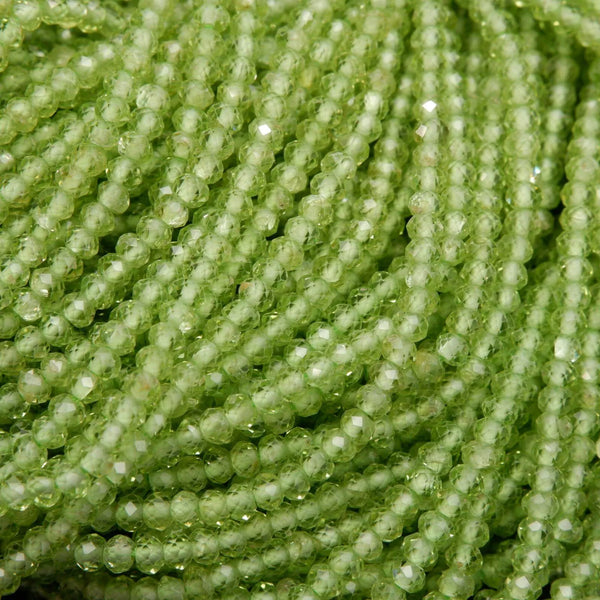
The color runs from a bright yellow-green through grass green to a deeper olive, and it stays the same under daylight and lamplight. Bead peridot is usually small and transparent to translucent, and most strands carry some natural inclusions: tiny crystals, fine needles and the disc-shaped lily pad inclusions that identify the stone. Color varies between strands more than within them.
Peridot is almost always faceted or microfaceted, because the cuts throw light through the transparent body and make the green glow; smooth beads show a quieter, oily luster. At 6.5 to 7 on the Mohs scale it is hard enough for regular wear but a little softer than quartz, and it is sensitive to acids, so keep it away from household cleaners, hairspray and prolonged contact with sweat. Avoid ultrasonic and steam cleaning.
Formation and origin
Olivine is one of the most abundant minerals in the earth's mantle, and peridot reaches the surface in 2 main ways: carried up as nodules inside basalt lava, or exposed when deep mantle rock is pushed up along fault zones. The iron that gives the color is part of the mineral itself, so every olivine is green; the lower the iron content, the more yellow the stone. Historic peridot came from Zabargad Island in the Red Sea. Today the main sources are the San Carlos Apache Reservation in Arizona, the Kohistan region of Pakistan, Myanmar, China and Vietnam. Peridot also occurs in pallasite meteorites.
Pairings
Aquamarine beads: pale blue and yellow-green are both light, clear colors, and faceted strands of each sparkle together.
Sapphire beads: deep blue sapphire sets off the bright green, and its hardness protects the strand.
Tanzanite beads: violet blue against olive green is a strong complementary pairing in faceted strands.
Lore and Meaning
Peridot has long been linked with the sun. Ancient Egyptians called it the gem of the sun and mined it on Zabargad, and it is one of the birthstones for August. In crystal traditions peridot is associated with abundance, warmth and letting go of resentment, and it is commonly placed with the heart and solar plexus chakras. It has also been worn as a token of good fortune and friendship. These are traditional beliefs, not claims of physical effect.